Fayu And The Dariya Ka Jinn
MY THOUGHTS
Don’t you love a book with a little magic and folklore thrown in? I don’t know whether the Dariya ka Jinn is a real folktale or a touch of magic created for this story, but it is so bewitching! Author-illustrator Rahil Mohsin is known for starting Hallubol, the first-ever Dakhni motion-comic series, and it is so fitting that he should be part of Pratham’s first-ever comic book offering.
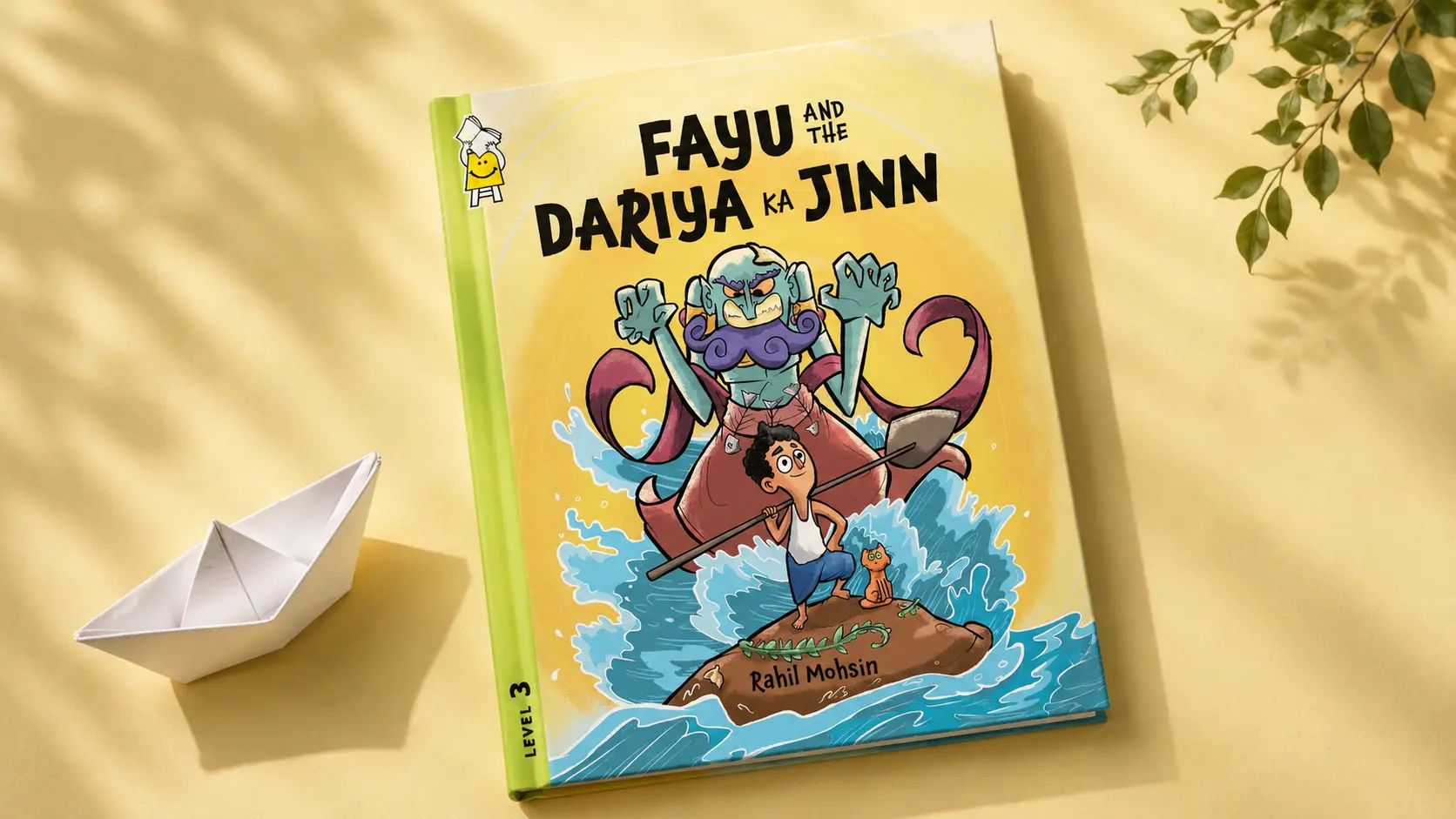
Budding chef, Fayu has a hankering for Machchhi ka salan but realises there is no dish at home! He rushes to the river to catch some fish as his grandmother asks him to be careful of the Dariya ka Jinn. But a strong current capsizes Fayu’s boat, and he comes face to face with the Jinn! Fayu cleverly tries to escape being eaten by the Jinn by promising to feed him the tastiest fish curry in all the universe! Will the Jinn like the fish curry and spare Fayu?
There are so many things to love about this book. The honest and endearing characters — Fayu, who lives with his grandmother and loves to cook; Fayu’s supportive and pious grandmother, who eagerly waits to taste Fayu’s culinary creation. Baabu the cat who sticks by Fayu, no matter what; and the Jinn, menacing, hungry, and utterly entertaining! It was refreshing to see a story set in rural coastal Karnataka, and I enjoyed Rahil Mohsin’s illustrations of houses, fields, and tiny details from that region. There is a fluidity to the book that engages the reader and forces them to move with the action from the house and town to the river, where the tempo shifts from the languidity of the town to the frenetic pace of the current and waves and then on to the heated action of the kitchen.
This is a lovely way for emerging readers to transition from picture books to reading independently. The dialogue bubbles help move the action, and the sequential panels encourage them to read the story in a particular order. If you are still wondering about the difference between picture books and comic books, here are a few helpful pointers.
Use code PBMOR10 for a 10% discount!
Rigid boundaries: A comic book uses boundaries or panels through which the story is told sequentially, so readers must follow the sequence to understand the story. A picture book uses full-page illustrations or spreads with text lines or paragraphs without any boundaries.
Narrative style: A comic book uses visuals as its primary narrative, making the reader infer the story, action, emotion, etc from the visuals while the text supplements with dialogue. In a picture book, the text can be read out loud, and it can still make sense. The pictures add supplementary information.
Audience: A comic book is seldom used for a read-aloud, making it perfect for children who are transitioning into reading on their own. A picture book, on the other hand, is perfect for read-alouds and is typically for younger early readers.
Add this book to your bookshelf today!
Use code PBMOR10 for a 10% discount!
If you think your child would enjoy this book, you can buy it here →
Disclosure: Mother of Readers is a participant in the Amazon Associates Program and other affiliate programmes. If you purchase through our links, we may earn a small commission, at no additional cost to you. Every book recommended here is thoughtfully read and reviewed.